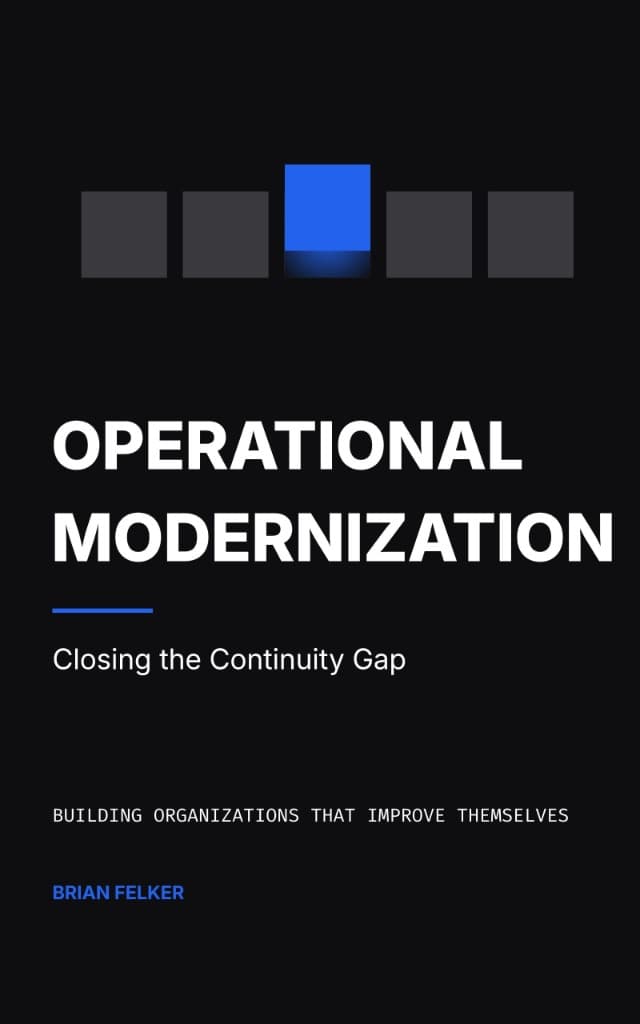
OPERATIONAL MODERNIZATION
Closing the Continuity Gap
Organizations have spent decades trying to continuously improve how work gets done.
Until now, no management discipline has been able to do it across the entire enterprise. AI changes that.
The Hidden Tax on Growth
Every organization wants the same thing: to grow. But growth has a side effect that rarely shows up on a P&L — complexity.
Every new customer, employee, system, and process adds coordination requirements. Left unmanaged, that complexity quietly becomes one of the largest constraints on future growth.
It builds slowly, through hundreds of individually reasonable decisions. A spreadsheet bridges a reporting gap. A new hire absorbs a process nobody redesigned. A weekly meeting compensates for data no one fully trusts.
Each decision makes sense in isolation. Together, they become the operating model.
Operational Friction
Operational Friction is a hidden tax on growth — self-imposed, and paid every single day.
The Rise of Human Middleware
As systems fail to talk to each other, an organization's most capable people quietly become the connective tissue — manually moving information between the boxes that should be moving it themselves.
The Economics Have Changed
Fixing how a business operates was once reserved for the largest companies — the ones who could absorb a six-figure consulting engagement and a multi-year implementation.
Cloud computing, modern APIs, and artificial intelligence have collapsed that cost curve.
McKinsey estimates...
...generative AI could unlock $2.6-4.4 trillion in annual value.
But only for organizations that redesign how work gets done, not those that simply deploy the technology.
The Continuity Gap
Every major management discipline solved part of the problem. Lean, Six Sigma, Agile, and DevOps made improvement continuous — but largely within functions.
BPR and Enterprise Architecture reached across the enterprise — but episodically.
One quadrant remained empty.
Lean • Six Sigma • Agile • DevOps • Revenue Operations
Continuous practice, confined to one function.
THE CONTINUITY GAP
The empty quadrant. No discipline has filled it — until now.
Departmental Projects
One-off fixes inside a single team.
BPR • Enterprise Architecture • Transformation Offices
Enterprise-wide reach, but project-based.
AI collapses the marginal cost of continuously observing how work happens, identifying friction, redesigning workflows, and evolving the operating model — activities every organization has always needed to do, but could never afford to do continuously, at enterprise scale, until now.
What Actually Changes
The Continuity Gap explains the management theory. This is the practical manifestation — what Operational Modernization actually does to how work moves through an organization.
The seams between functions, redesigned.
For the people who used to hold this together, the change is immediate — less time reconciling reports, more time on the judgment calls that actually need them. For the organization, it's compounding: every redesigned seam is one less place for the next handoff to break.
The Opportunity in Front of Us
The next generation of great companies won't be defined by the technology they adopt.
They'll be defined by how intentionally they redesign the way they operate.
Who owns the continuous improvement of your operating model?
If the answer is “everyone,” “the COO,” “IT,” “Transformation,” or “it depends” — the Continuity Gap may already exist inside your organization.
Executive Overview
Understand Operational Modernization in 10 Minutes
A concise introduction to the core argument, frameworks, and vocabulary behind Operational Modernization, designed for executives, clients, academics, journalists, and anyone who wants to understand the idea before diving into the full book.
Who Should Read It
CEOs
Trying to scale without adding organizational complexity.
COOs
Responsible for enterprise execution and removing bottlenecks.
CIOs & Tech Leaders
Deploying AI, automation, and core systems.
Transformation Leaders
Redesigning operating models for the digital era.
Consultants & PE Partners
Working across functional boundaries to drive portfolio value creation.
Professors & Students
Studying the future of management and organizational design.
What Does Better Actually Look Like?
“We want people to love working here.”
Reduce friction, eliminate unnecessary manual work, improve clarity, and allow talented people to spend more time creating value.
“We want to be easy to do business with.”
Reduce handoff failures, decision delays, fragmented information, and unnecessary complexity across the customer journey.
About Brian Felker
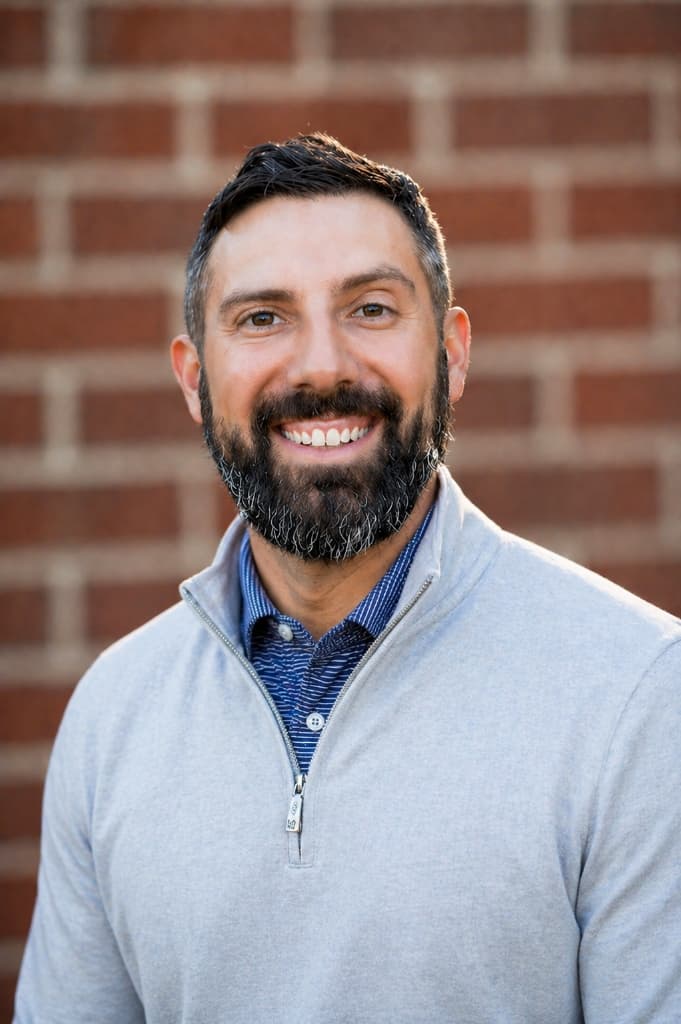
Brian Felker is the founder and managing partner of The Growth Nerd, where he works with executives on operational modernization, AI strategy, growth, and organizational performance.
His career spans more than two decades across enterprise technology, high-growth companies, sales leadership, business operations, and advisory work.
Operational Modernization grew from a recurring pattern he observed across those environments: organizations frequently invest heavily in improving individual functions while the systems connecting those functions remain largely unmanaged.
Bring Operational Modernization Into the Conversation
Media & Podcasts
Brian is available for interviews, podcasts, guest articles, and commentary on:
- Operational Modernization
- The Continuity Gap
- Human Middleware
- AI and the future of work
- Operational Debt
- Organizational design
- Continuous improvement for knowledge work
Speaking & Executive Briefings
Available for:
- Keynotes
- Executive leadership sessions
- Workshops
- Company offsites
- Conference presentations
Universities & Business Schools
Available for:
- Guest lectures
- MBA classes
- Executive education
- Faculty discussions
- Classroom Q&A
Interested in Applying Operational Modernization?
The Growth Nerd works with organizations to identify operational friction, redesign workflows and operating models, and apply AI and technology to improve how work gets done.
Start a Conversation